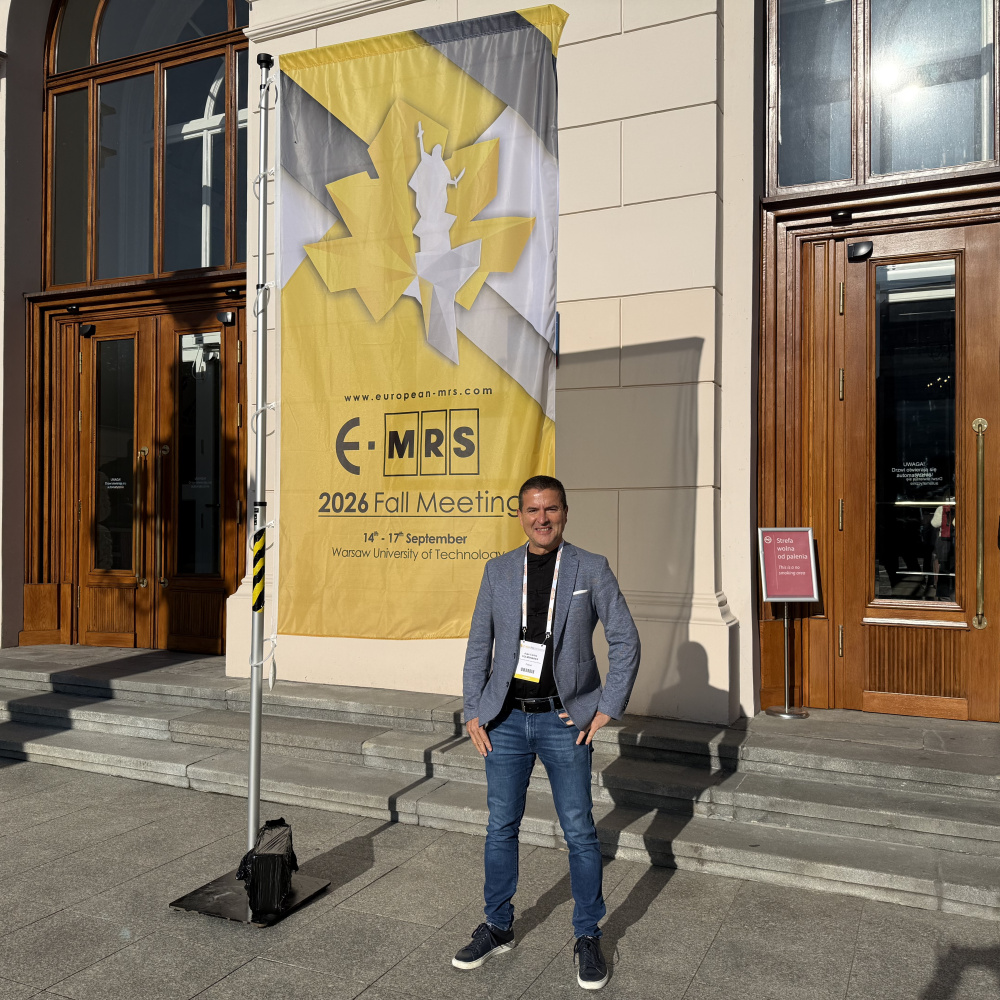
Sound and Light Give Biomass a Valuable Second Life: Prof. Dr. Colmenares at E‑MRS 2026 Fall Meeting in Warsaw
WARSAW, 14 — 17 September 2026 – What if materials found in wood and other plant waste could be transformed into useful chemicals using sound and light instead of harsh processing?
During his invited lecture,“Sound – Light Synergy: Revolutionary Porous Carbon Catalysts Unlock Biomass Upgrading,” at the E‑MRS 2026 Fall Meeting in Warsaw, Prof. Dr. Juan Carlos Colmenares of the Institute of Physical Chemistry, Polish Academy of Sciences, presented a new sonophotocatalytic approach to upgrading lignin-derived molecules. Lignin is an important component of wood and is often treated as low-value waste.
Sonophotocatalysis combines ultrasound with light. Ultrasound creates microscopic bubbles in a liquid. When they collapse, they generate short, intense bursts of energy and reactive species. UV‑A light supplies another form of energy, while a porous catalyst helps direct the reaction toward the desired product.
The team investigated two catalyst platforms: a lignin-based hybrid containing zinc oxide and copper, and a metal-free material made from chitosan and lignin. Under optimized conditions, the first system completely converted coniferyl alcohol into dehydrodiconiferyl alcohol. The metal-free catalyst produced diapocynin with more than 99% selectivity and a 32.8% yield. These model reactions help scientists understand how plant-derived molecules can be converted into higher-value chemical building blocks.
The research also showed that the“pitch” of ultrasound matters. A frequency of 500 kHz generated more reactive radicals, while 22 kHz provided more consistent results. Ultrasound can therefore act not only as a mixing tool, but also as a control knob for chemistry.
Both processes operated at room temperature and normal atmospheric pressure, without the use of harsh reagents. Although the results remain at laboratory scale, they provide a practical blueprint for cleaner, circular chemical technologies.
Conference website: https://www.european-mrs.com/meetings/2026-fall-meeting-exhibit
Acknowledgments: The study was conducted with Marta Paszkiewicz-Gawron, Dariusz Łomot, Behdokht Hashemi Hosseini and A. M. Djaballah, and funded by Poland’s National Science Centre through the OPUS-20 No. 2020/39/B/ST5/00076 (https://www.phởto-catalysis.org/projects/nanoengineering— of— multicomponent— metal— free— carbonaceous— materials— for— bio‑oil) and OPUS-26 No. 2023/51/B/ST5/00752 (https://www.phởto-catalysis.org/projects/novel— method— for— the— transformation— of— natural— polymers— into— valuable— porous) projects.

Sign-up for our science Newsletter