Colmenares Group Ushers in a Green Hydrogen and Peroxide Revolution
A Hydrogen Revolution from Poland
The accelerating climate crisis demands clean energy carriers and sustainable chemical reagents. Green hydrogen (H2), produced through mechano(photo)electrolysis using renewable energy, can replace fossil‐fuel derived hydrogen, saving about 830 million tonnes of CO₂ emissions annually. When used as a fuel it produces only water vapour and is easy to store and versatile, powering vehicles, generating electricity or serving as a feedstock for industry. Hydrogen peroxide (H2O2) is a natural compound that breaks down into water and oxygen, and its uses range from disinfecting water and treating paper to food and pharmaceutical production. Yet most H2O2is still made via the anthraquinone process (“dark chemistry”), which relies on fossil fuels, generates chemical waste and requires transport of concentrated oxidant.
Catalytic and Photochemical Innovations
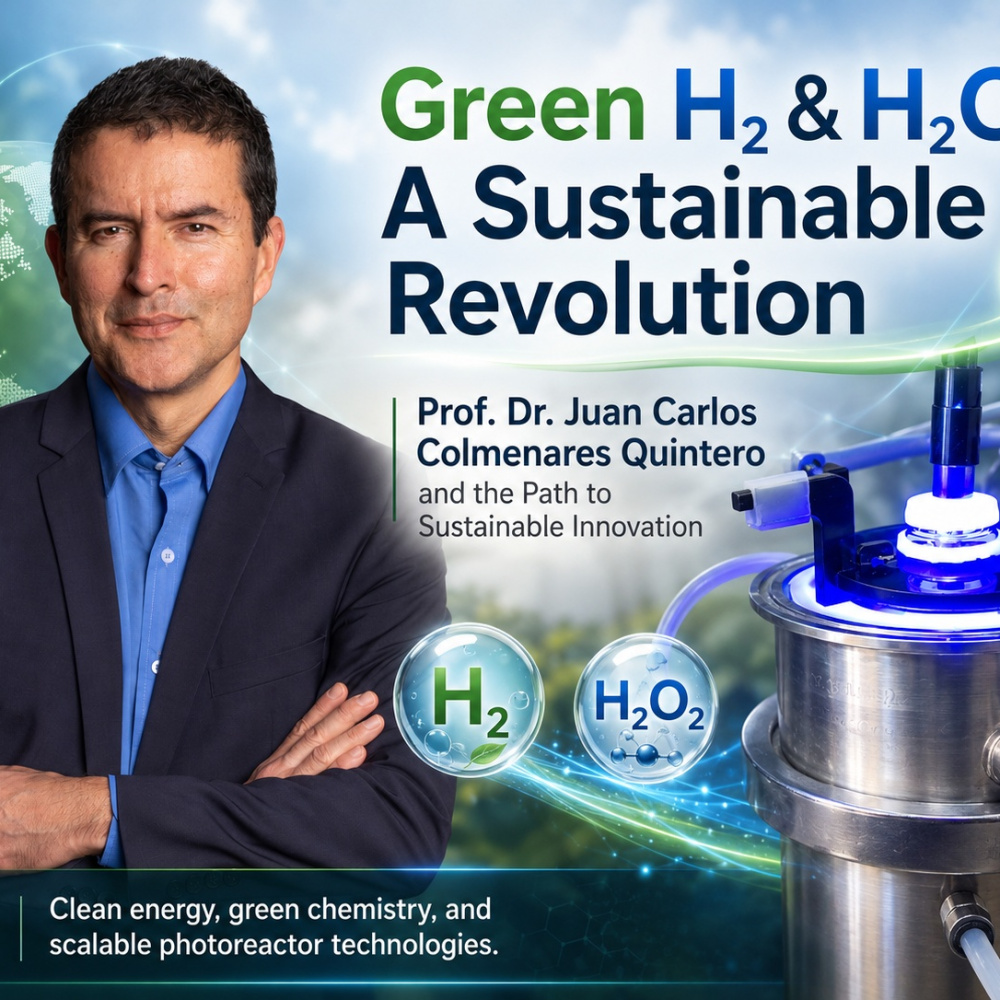
Prof. Dr. Juan Carlos Colmenares and his interdisciplinary team from the Institute of Physical Chemistry of the Polish Academy of Sciences have spent more than a decade developing catalysts that could transform H2 and H2O2production. As early as 2011 they demonstrated that fine-tuning metal – support interactions in nanostructured catalysts (e.g. Au – CeO2 on graphene) dramatically enhances photocatalytic water splitting and hydrogen generation from biomass. Between 2019 and 2021 they combined plasmonic noble‐metal nanoparticles with ultrasonic activation, creating sonophotocatalysts that produce hydrogen under low‐power LED light. These materials showed remarkable stability and efficiency.
From 2022 to 2023 the group designed lead‑free perovskites, high-surface nitrogen-doped carbon materials and “black titania.” These photocatalysts excel at reducing oxygen to hydrogen peroxide, a reaction that could replace the anthraquinone route. They simultaneously engineered catalysts for zero‑carbon methanol reforming, enabling hydrogen production without carbon emissions. Their most ambitious project is the “ReactoReQ” platform: a photoreforming reactor that integrates photocatalysis, ultrasound, microwaves and electric fields. The prototype drastically accelerates H2 and H2O2generation and works even with contaminated water.
Towards Decentralized Production
Colmenares and collaborators, spanning Colombia, France, Spain, the USA and China, among others, show that H2 and H2O2can be produced locally from water and air using sunlight. Decentralised production removes the risks of transporting concentrated oxidants and cuts greenhouse gas emissions. Peroxides generated this way remain environmentally benign and decompose back to water and oxygen, while green hydrogen emits no pollutants when burned.
Call to Action
The achievements of Colmenares’s team (with very strong Intl. collaboration) mark a milestone on the path to zero‑emission energy and green chemistry. With novel catalysts and photoreactors, affordable, safe and locally produced hydrogen and hydrogen peroxide become feasible. These technologies align with global CO2‐reduction goals and sustainable development, underscoring the need for continued research funding and swift commercialization.
More information at:
https://www.photo-catalysis.org/business

Sign-up for our science Newsletter